
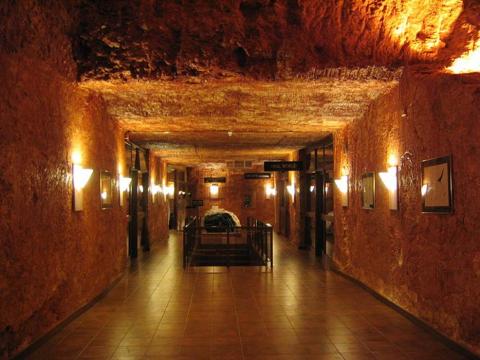
The town of Coober Pedy, in South Australia, is a very interesting place. Although there have been people living in the area for a long time, other parts of the world only learned about the region's existence in 1858 when an explorer from Scotland, McDouall Stuart, travelled nearby. It was later still, in 1915, that the town was constructed. This followed an important discovery in the area when highly coloured, precious stones called opals were found in large amounts. By 1999, opal mining had become an important industry for the area, and nowadays, Coober Pedy is often referred to as the opal capital of the world.
Another reason why Coober Pedy is so well known is that many people live in houses which, unusually, are located underground. These houses look similar to caves and being underground means they can remain cool in high temperatures. On the surface, these are regularly over 40°C in the summer. What's more, the temperature below ground stays constant through the year. The town gradually became a popular tourist destination, and over time, mines were opened to the public and hotels were built. Tourists also wanted to see the houses and explore the underground churches. Because these buildings are constructed underground, no sounds from the outside can be heard.
Since 1987, there has been a particular increase in tourist numbers. It was at that time that a main road called the Stuart Highway was completed. Visitors without their own transport still have various options to reach the town, including arriving by train, or by a coach which arrives once a day. The train station is outside the town, and people need to plan any trip carefully as the service only runs once a week.
Tourists are also strongly advised to avoid visiting at certain times of year due to the extreme heat. Making trips during January and February is particularly challenging, with April to October being seen as a far more sensible choice.
 Look up dictionary