
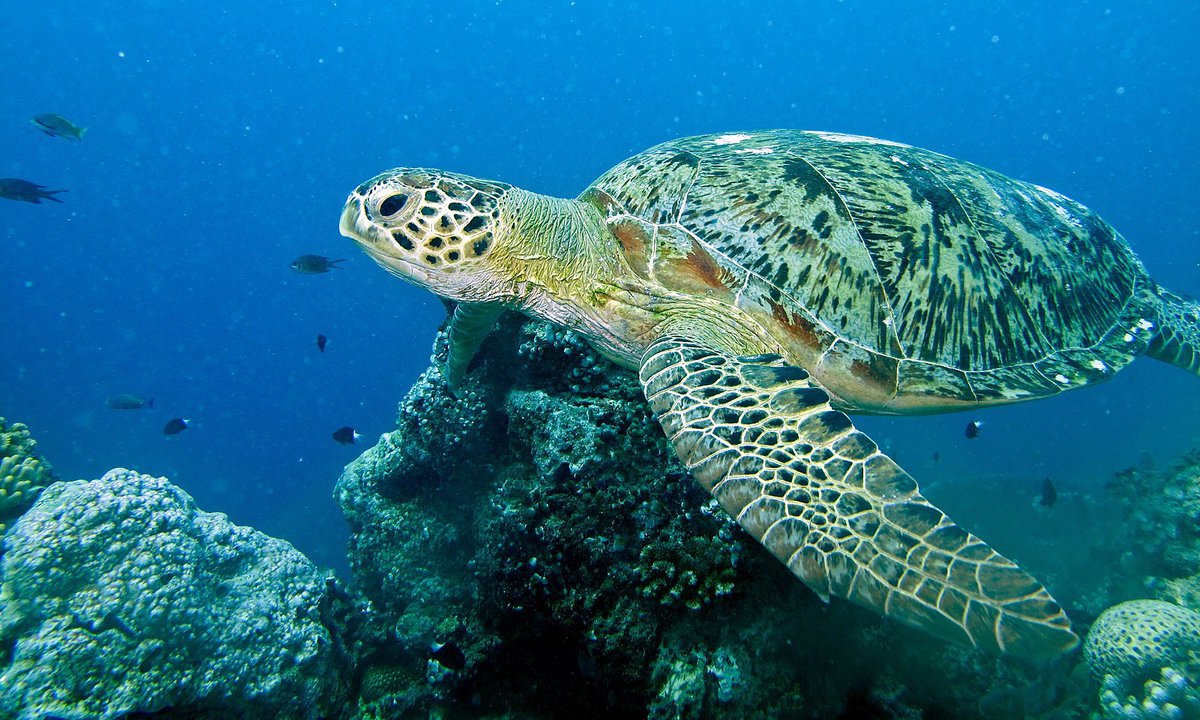
The green turtle is the second largest of the seven species of sea turtle and grows to a length of around 140 centimetres. It spends most of its life in the open ocean. The hard, protective shell covering its back is often green in colour, and you might assume it is this feature which gives the turtle its name. However, it actually comes from the fat beneath the shell, which is a delicate shade of green. This species of turtle has two bone-like plates near its eyes that distinguish it from other species of turtle, which have more.
Female green turtles return to the beach where they were born to lay their eggs. They dig a large hole before filling it with up to 200 eggs, which they cover with sand. Foxes eat turtle eggs if they can find them, so the sand provides protection. The babies emerge at night and head for the sea, but even so, many tiny turtles are eaten by birds as they make their way down the beach.
The turtles feed primarily on small creatures at this stage but consume increasing quantities of plant-based materials as they mature. When they are fully grown, they are totally vegetarian, the only turtle species to be so.
Apart from when they are new-born or laying eggs, green turtles spend their entire lives at sea. Few animals are large or powerful enough to eat an adult green turtle, although tiger sharks occasionally attack them. Green turtles are capable of holding their breath for around five minutes when active but can do so for several hours when sleeping. This avoids the need for them to stay close to the surface, where it's not safe, and allows them to remain hidden among rocks when inactive at night.
Male and female green turtles can look surprisingly similar. Size is not necessarily a good indication of which is which, as mature males and females are roughly similar in length and weight. Additionally, a male that is larger than a female may simply be older. It has a longer tail when compared to the female, and it is this feature which is used to identify the gender.
Green turtle numbers worldwide are declining. They can accidentally eat plastic waste in the sea, which is a serious threat for them, and they sometimes get caught in fishing nets too. The International Union for Conservation of Nature lists animals and plants according to how common or threatened they are. Two of the seven types of sea turtle, the green turtle included, are seen by the organisation as endangered, so it's not just conservationists who should be concerned: we all need to be!
 Look up dictionary