
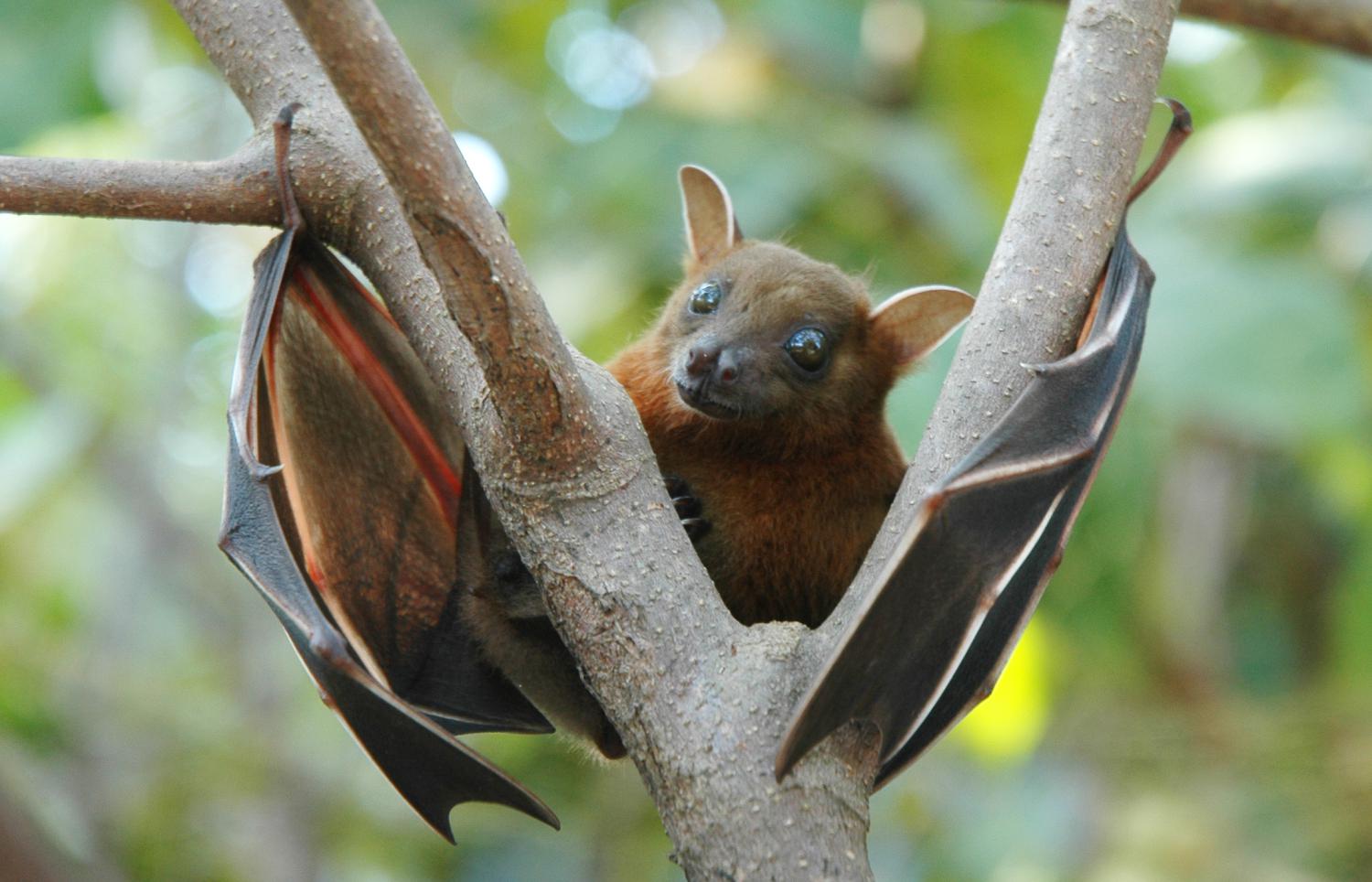
Fruit bats are flying mammals named because of their habit of living on a diet of various tropical fruits and plants. There are over 170 different species around the world. Although mainly found in Africa, some can also be found in sites in Southeast Asia and Central and South America.
While most bats measure only a few centimetres in length, fruit bats are, on average, the largest bat species in the world. They range in size from the flying fox, which has wings up to 1.7 metres across when fully extended, down to the spotted-winged fruit bat, whose open wings measure around 28 centimetres from end to end.
Fruit bats are nocturnal, which means they usually only come out at night to feed. The most likely explanation for this is that the bat is trying to avoid dangerous animals such as rats. In island locations especially, these can seriously reduce numbers. Despite sharing certain types of behaviour with other bat species, fruit bats are unique in some respects. When it comes to flying at night, fruit bats regularly use smell to work out where they are going, whereas most bat species use sound to achieve this. It is unclear whether fruit bats simply lost that ability at some time in the past or just never developed it in the first place.
Fruit bats are among the most social of all mammals. With a few exceptions, they usually live in large groups of up to 200000 individuals. They gather at the end of the night when they have finished feeding and remain together until the next night. They do this in a variety of places including caves, bushes and even empty buildings, although more than half of all species are found in trees, sometimes in such large numbers that the branches can break under their weight. The size of the groups may be related to the availability of local food. In places where there is plenty, the bats will form even bigger groups.
Female fruit bats are responsible for almost all the care of their young bats, known as pups. Research has shown that these remain with their mothers for around the first four months of their lives, receiving both milk and protection. It takes about two years for young bats to become adults. They can then live for up to 30 years.
While fruit bats are not yet an endangered species, they are increasingly at risk, for example from humans clearing land for farming. It is unclear at the moment exactly how much impact climate change is having on fruit bats, but it appears to be significant.
 Look up dictionary