
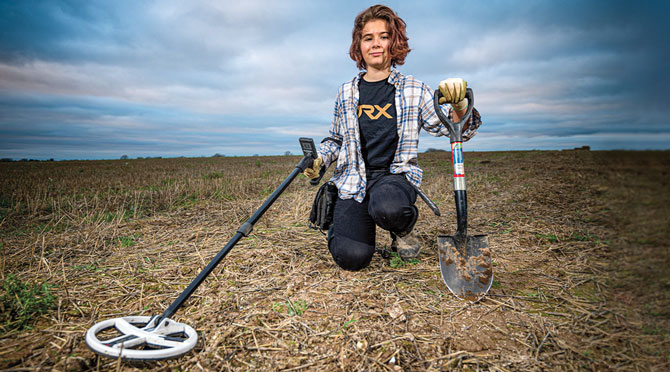
Anna Roper meets 15-year-old metal detectorist Daniel Owen and his father Joe.
Daniel Owen smiled as he remembered when he'd discovered an unusual 7th-century gold bracelet in a field in the north of England. 'Normally when I'm metal-detecting, it's hours before I find anything interesting,' he told me. 'But that day I'd only been going 10 minutes when my detector made the beep-beep sound telling me I'd found metal in the ground. I saw a strange shape sticking out of the mud. I just picked it up. I didn't have to dig - I couldn't believe it.' Daniel then explained that he wiped the object clean. 'I didn't know exactly what it was, but was thrilled all the same.'
Daniel showed the object to his father Joe and other detectorists searching the same field. 'People were surprised at Daniel's success rates,' Joe laughed. 'In the last year, he's made four big discoveries, and everyone was delighted for him.' That afternoon, Daniel and Joe took the object to be analysed at a local museum. 'It could be vital archaeological evidence,' Joe explained. 'I've been metal-detecting for 30 years and I introduced Daniel to it. I still get excited by the idea of looking for treasure but being in green spaces in the fresh air is what most appeals to me.' His son agreed with him.
Daniel and Joe belong to a metal-detecting club. 'It's best to join one,' Daniel said, 'especially if you're inexperienced. If something goes wrong with your device, or you fancy getting an expensive upgrade, someone in the club will give you guidance. Also, you always need permission from the owner of the land before you search it, and that can involve many complicated forms to fill in - the club does all that for you. If a particular area of land is known to have important historical remains, then metal-detecting will probably be banned there, though in most parts of the UK it's allowed. In some countries, metal-detecting is illegal.'
Metal-detecting has changed recently. It used to be seen as a strange, old-fashioned hobby mostly done by older men. However, it's not like that these days. Over 40% of the members of the club that Daniel and Joe belong to are women, of whom 45% are under-30s. The club has a children's section and several teenage members. Daniel says that not many of his school friends are metal detectorists, but several of them believe it's an interesting hobby to have.
The relationship between metal detectorists and archaeologists has also changed in recent years in the UK. As increasing numbers of people took up metal-detecting and there were more private buyers for ancient objects, archaeologists were concerned that historical evidence was disappearing. Eventually, stricter laws were introduced requiring metal detectorists to report any treasure they found. 'Some metal detectorists don't do that,' said Joe, 'but most follow the law. And our reputation has improved, even among archaeologists they depend on us for evidence they need for their research.' Archaeologist James Hunter confirmed this later: '95% of all reported treasure is from metal-detector users, with the rest being found by archaeologists.'
When I met up with Daniel in a large field near his home, he let me use his new metal detector. I was shocked at how much he'd paid for it. After three hours, I'd come across a couple of coins and two iron nails, all annoyingly modern and hardly what I'd call treasure. I'd planned to spend an hour metal-detecting but found it incredibly hard to stop, which is why it probably isn't the hobby for me it might take over my life. That's not something that bothers Daniel, though.
 Look up dictionary